flowchart TD
    A["Code Submission"] --> B["SonarQube Analysis<br/>(CWE mapping)"]
    B --> C["LLM Feedback<br/>(Level-appropriate)"]
    C --> D["Student View &<br/>Instructor Reports"]
Pedalogical
AI-Grounded Vulnerability Feedback for Non‑Security CS Courses
TL;DR
We propose a new tool and pedagogical approach to improve cybersecurity education.
Problem & Motivation
We Need to Improve Education in Developing Secure Code
Security failures start early.
Students often learn to write code before they learn to write secure code.
- Software vulnerability exploitation remains a leading vector in breaches; secure coding must be integrated early [1], [2], [3].
- Teaching students to use static analyzers early is important, but is very difficult due to the complexity of the output of these tools.
- Existing static analyzers flag issues but rarely deliver actionable, level-appropriate pedagogy [4], [5].
Prior Findings: What We Know So Far
Empirical evidence supports this gap.
- Vulnerabilities increase and diversify as students progress from CS1 → advanced courses [6].
- Many CS programs lack sustained, program-wide security practice; students introduce vulnerabilities in routine coursework [6], [7], [8].
- Mismatch between vulnerabilities students actually produce and those emphasized in detection research [8], [9].
- Time pressure & functionality-first norms drive insecure patterns; targeted feedback can help [7], [9].
Research Gap
Proposed Approach
Pedalogical
System Pipeline
Grounded analyzer reduces hallucination risk; LLM provides audience-appropriate feedback.
Pedagogical Learning Theories
Integrates proven learning theories into the system design to enhance the learning experience:
Pedalogical Application

Figure: Pedalogical Application
Pedalogical Question Nodes
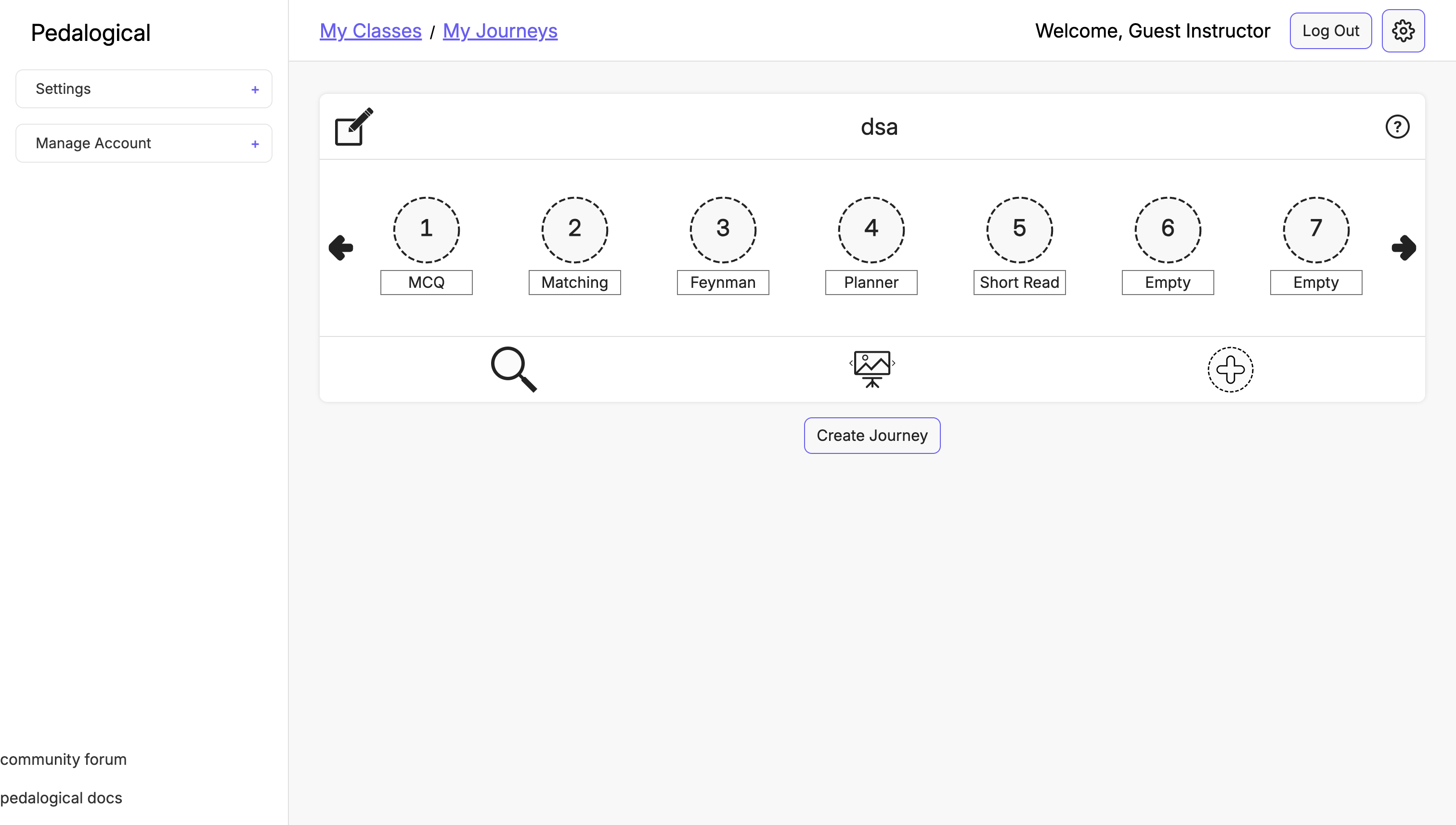
Figure: Pedalogical Question Nodes
Pedalogical LLM Question Generation
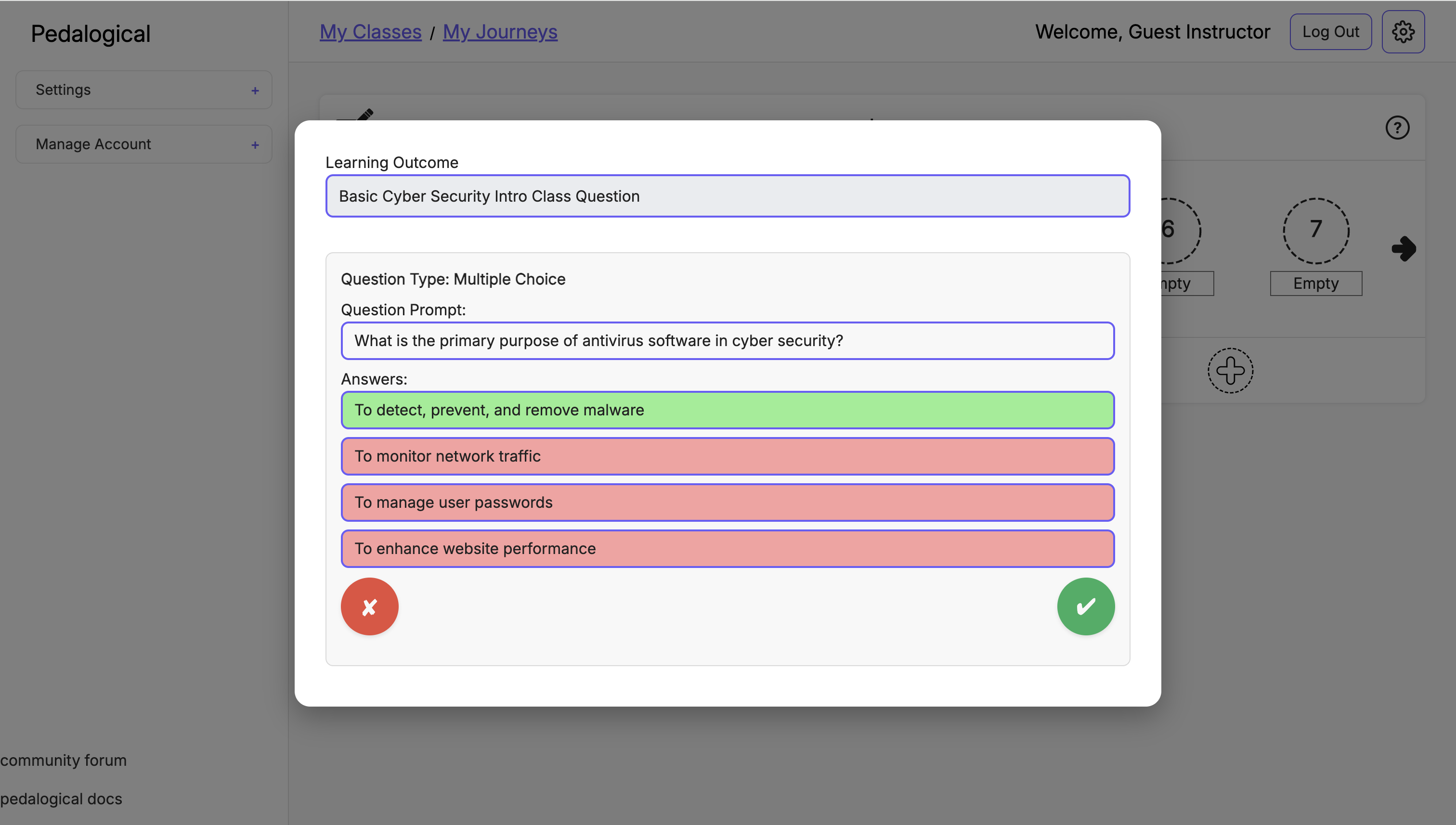
Figure: Pedalogical LLM Question Generation
Cybersecurity: Sample Student Feedback
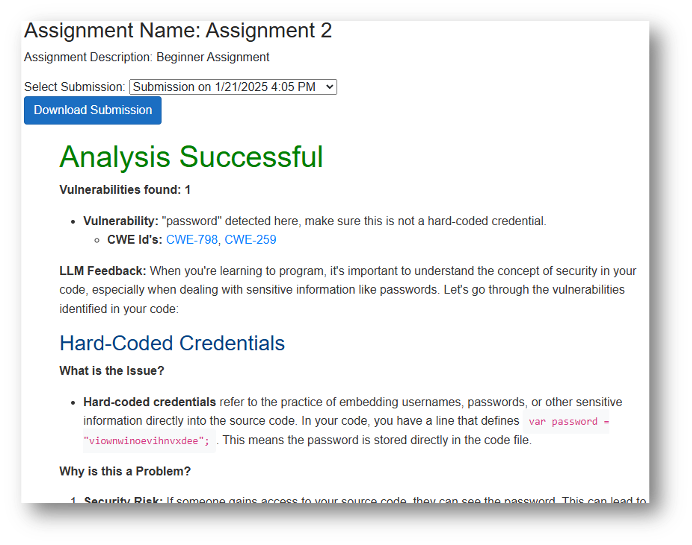
Figure: Sample Student Feedback
What Instructors Get
- Cohort dashboard: per-assignment vulnerability counts & trends.
- Downloadable reports: analyzer findings, prompts/responses, submission diffs.
- Configurable feedback detail level for scaffolding.
Sample Instructor Report
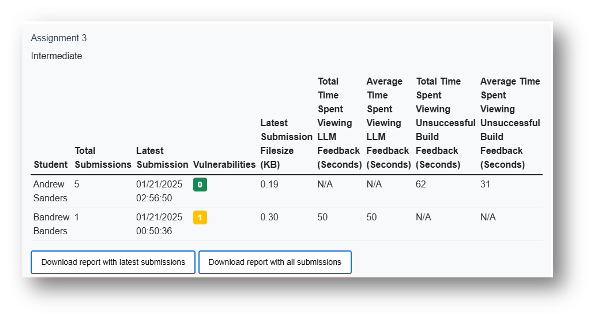
Figure: Sample Instructor Report
Proposed Study Context
Research Questions
RQ1: Is AI-generated vulnerability feedback associated with reduced vulnerabilities in revised submissions?
RQ2: Does exposure to AI-generated vulnerability feedback improve secure coding practices over time?
Proposed Study Context
- Multi-course, multi-institutional.
- Undergraduate courses (intro → advanced; multiple sections; in-person & online).
- Incentivized via bonus points contingent on meeting minimum functionality and reducing vulnerabilities.
Data & Measures
- Static analysis artifacts: CWE-tagged vulnerabilities, security hotspots, bugs, code smells.
- Engagement telemetry: time on feedback, resubmission frequency, interaction with explanations.
- Learning signals: pre/post patterns across assignments; regression models of engagement → reduction.
- Qualitative: end-of-semester survey on usefulness & strategies.
Analysis Plan
- Longitudinal within-course and cross-course comparisons.
- Regression modeling: engagement metrics → vulnerability change.
- Category-level success: which CWE types improve most?
- Sensitivity to bonus-point variability across courses (limitations acknowledged).
Expected Contributions
- A replicable pipeline for secure-coding feedback integrated into non-security courses.
- Evidence that grounded LLM feedback can reduce vulnerabilities and shape habits .
- A platform for program-level learning analytics on secure coding.
Anticipated Threats & Limitations
- Bonus-point schemes differ across courses → potential confounds.
- Structured prompts mitigate LLM variability, but do not eliminate it [12].
Encouraging Early Analysis
Pedalogical in a CS2 (Data Structures) Course
- Students designed and selected data structures for a medium-sized programming project.
- Experimental group used the Pedalogical chatbot for guided reasoning and scaffolding, while the control group used a generic ChatGPT-4.0 wrapper, enabling comparison of design quality, reasoning depth, and tool engagement.
- Students in the experimental group performed significantly better on project outcomes, suggesting increased metacognitive awareness and problem-solving strategies based on rubric-based grading.
Call to Action
- Adopt Pedalogical in non-security courses to normalize secure coding.
- Collaborate on cross-institutional studies and shared analytics.
- Extend to additional languages & rulesets; explore adaptive feedback policies.
Thank You!
Contact Information
Lucas Cordova
References
References
[1]
Verizon, “Verizon 2023 Data Breach Investigations Report,” Verizon Business. Accessed: Oct. 30, 2024. [Online]. Available: https://www.verizon.com/business/resources/reports/dbir/
[2]
“NIST Software Assurance Reference Dataset,” NIST Software Assurance Reference Dataset. Accessed: Feb. 22, 2023. [Online]. Available: https://samate.nist.gov/SARD
[3]
ABET, “Accreditation Changes.” Accessed: Feb. 02, 2023. [Online]. Available: https://www.abet.org/accreditation/accreditation-criteria/accreditation-changes/
[4]
“CWE - Frequently Asked Questions (FAQ).” Accessed: Mar. 08, 2023. [Online]. Available: https://cwe.mitre.org/about/faq.html
[5]
Hazim Hanif, Mohd Hairul Nizam Md Nasir, Mohd Faizal Ab Razak, Ahmad Firdaus, and Nor Badrul Anuar, “The rise of software vulnerability: Taxonomy of software vulnerabilities detection and machine learning approaches,” Journal of Network and Computer Applications, vol. 179, p. 103009, Apr. 2021, doi: 10.1016/j.jnca.2021.103009.
[6]
A. Sanders, G. S. Walia, and A. Allen, “Analysis of Software Vulnerabilities Introduced in Programming Submissions Across Curriculum at Two Higher Education Institutions,” in 2024 IEEE Frontiers in Education Conference (FIE), Oct. 2024.
[7]
John Zorabedian, “Veracode Survey Research Identifies Cybersecurity Skills Gap Causes and Cures,” Veracode. Accessed: Jul. 12, 2023. [Online]. Available: https://www.veracode.com/blog/security-news/veracode-survey-research-identifies-cybersecurity-skills-gap-causes-and-cures
[8]
A. Sanders, G. S. Walia, and A. Allen, “Assessing Common Software Vulnerabilities in Undergraduate Computer Science Assignments,” Journal of The Colloquium for Information Systems Security Education, vol. 11, no. 1, p. 8, Feb. 2024, doi: 10.53735/cisse.v11i1.179.
[9]
T. Yilmaz and Ö. Ulusoy, “Understanding security vulnerabilities in student code: A case study in a non-security course,” Journal of Systems and Software, vol. 185, p. 111150, Mar. 2022, doi: 10.1016/j.jss.2021.111150.
[10]
J. Sweller, J. J. van Merriënboer, and F. Paas, “Cognitive architecture and instructional design: 20 years later,” Educational Psychology Review, vol. 31, no. 2, pp. 261–292, 2019.
[11]
L. S. Vygotsky, Mind in society: The development of higher psychological processes. Cambridge, MA: Harvard University Press, 1978.
[12]
Y. Shen et al., “ChatGPT and other large language models are double-edged swords,” Radiology, vol. 307, no. 2, p. e230163, 2023, doi: 10.1148/radiol.230163.