flowchart LR
    A[Explain] --> B[Predict]
    B --> C[Reflect]
    C --> D[Revise]
    D --> B
Not All Chatbots Teach
Evidence for Pedagogical Design in AI-Assisted Technical Education
Why this paper/talk?
Problem & Research Question
Problem framing
Research question
Does integrating metacognitive scaffolding into an AI assistant improve student performance compared to an unstructured Generative AI wrapper with the same model access?
Background / Related Work
Unstructured AI use: risks
Structured AI design: benefits
Pedagogical Tool Design
Grounded in The Feynman Technique: Explain → Predict → Reflect → Revise
Figure 2: Scaffold operationalizing the Feynman-inspired Explain → Predict → Reflect → Revise loop.
Pedagogical Learning Theories
Integrates proven learning theories into the system design to enhance the learning experience:
- Feynman Technique [19]: explain concepts in one’s own words to enhance retention and comprehension.
- Cognitive Load Theory [20]: convert verbose analyzer output → concise, relevant guidance (reduce extraneous load).
- Zone of Proximal Development [21]: feedback level aligned to course maturity (scaffolding).
Pedalogical Application

Figure 3: Pedalogical Application
Pedalogical Question Nodes
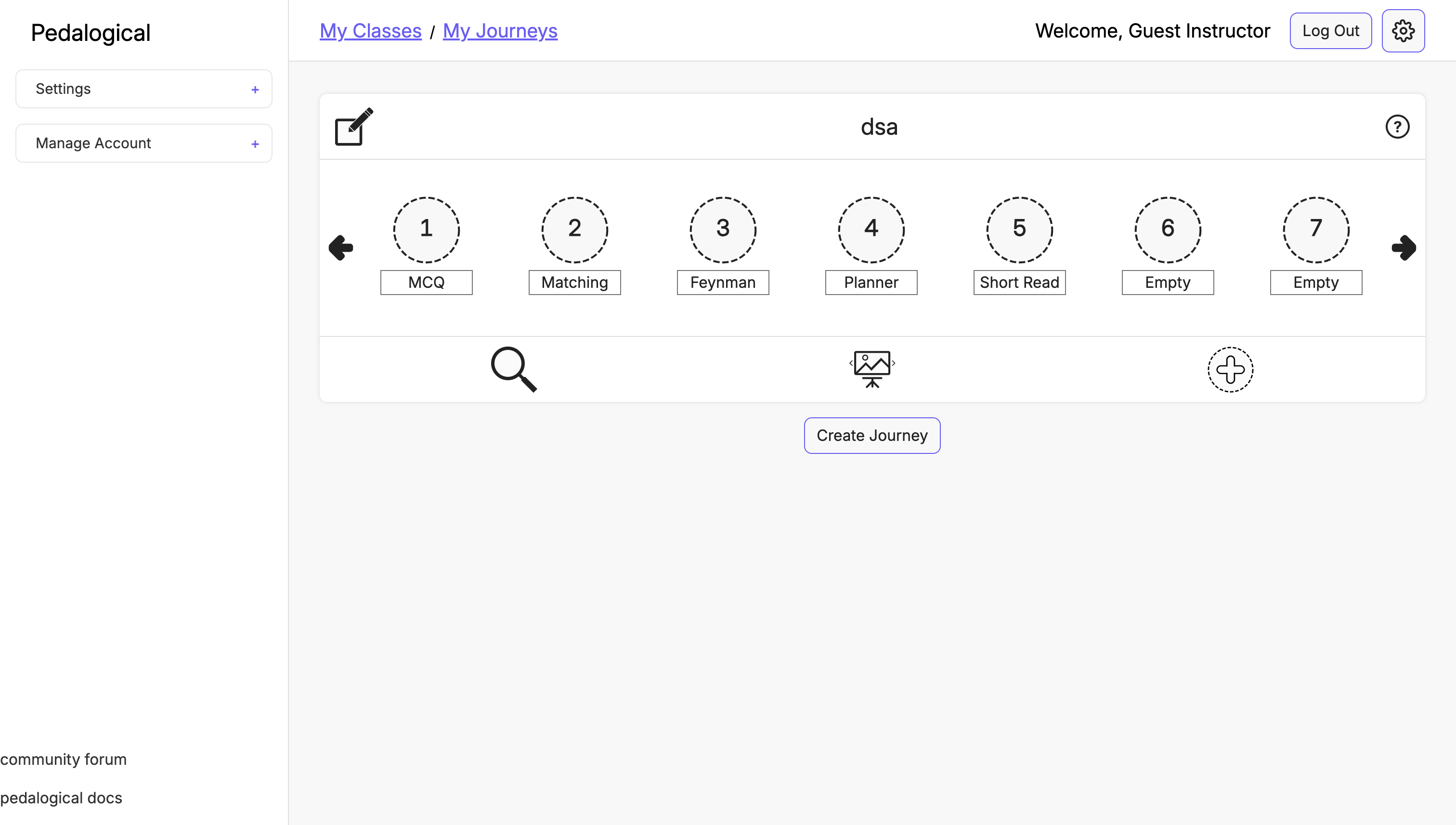
Figure 4: Pedalogical Question Nodes
Pedalogical LLM Question Generation
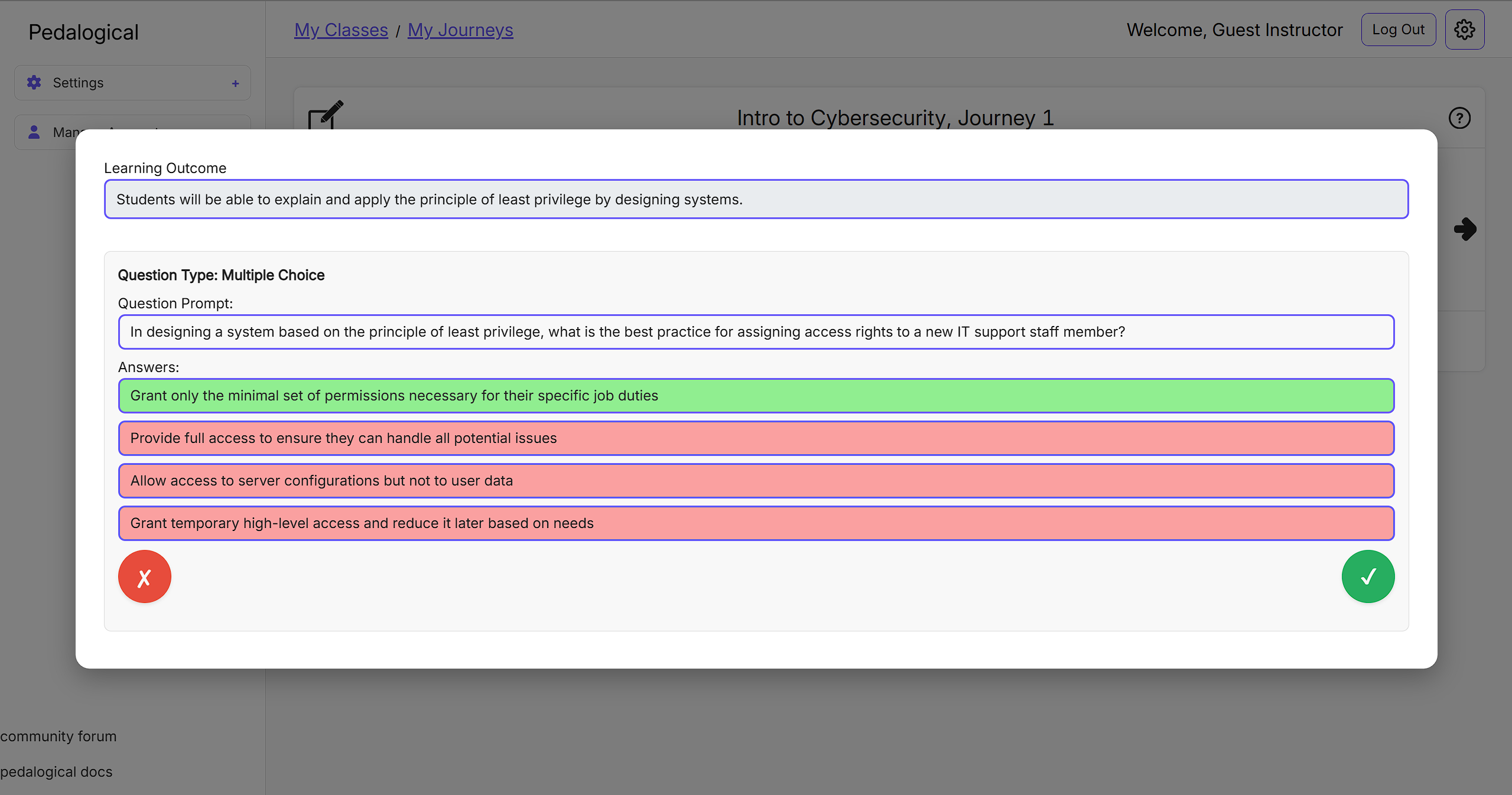
Figure 5: Pedalogical LLM Question Generation
Prompt intents & light statefulness
- Concept Articulation (own words) → clarify mental model.
- System Reasoning (constraints) → apply principles.
- Diagnostic → surface gaps/assumptions.
- Justification → trade‑offs and rationale.
- Light statefulness → earlier answers steer follow‑ups (e.g., check prior claims).
Beyond programming
- Networking: Subnet reasoning; routing constraints; misconfiguration diagnosis; DNS failure prediction
- Cybersecurity: Risk analysis; firewall rule revision; trade-off justification
- Software Engineering: Debugging; testing rationale; cause–effect reasoning
- Data Science / AI: Model evaluation; metric justification; bias and leakage detection
- Systems Administration: Failure cascade prediction; assumption checking
- Project Management / DevOps: Design trade-offs; pipeline optimization; resource reasoning
Study Design
Context & participants
- Undergraduate Data Structures, Spring 2025, liberal arts university.
- Two sections: Structured assistant (n=19) vs. Unstructured wrapper (n=17).
- Same instructor, assignments, rubric, incentives.
Assignment & conditions
- Project: “Bistro Ordering System.”
- Requires data‑structure selection/justification, working program, and documentation.
- Treatment: gated E‑P‑R‑R prompts with reflection checkpoints.
- Control: same UI; minimal pre‑prompt; free ChatGPT queries; no scaffolds.
Treatment: Interaction Snapshot (Structured Assistant)
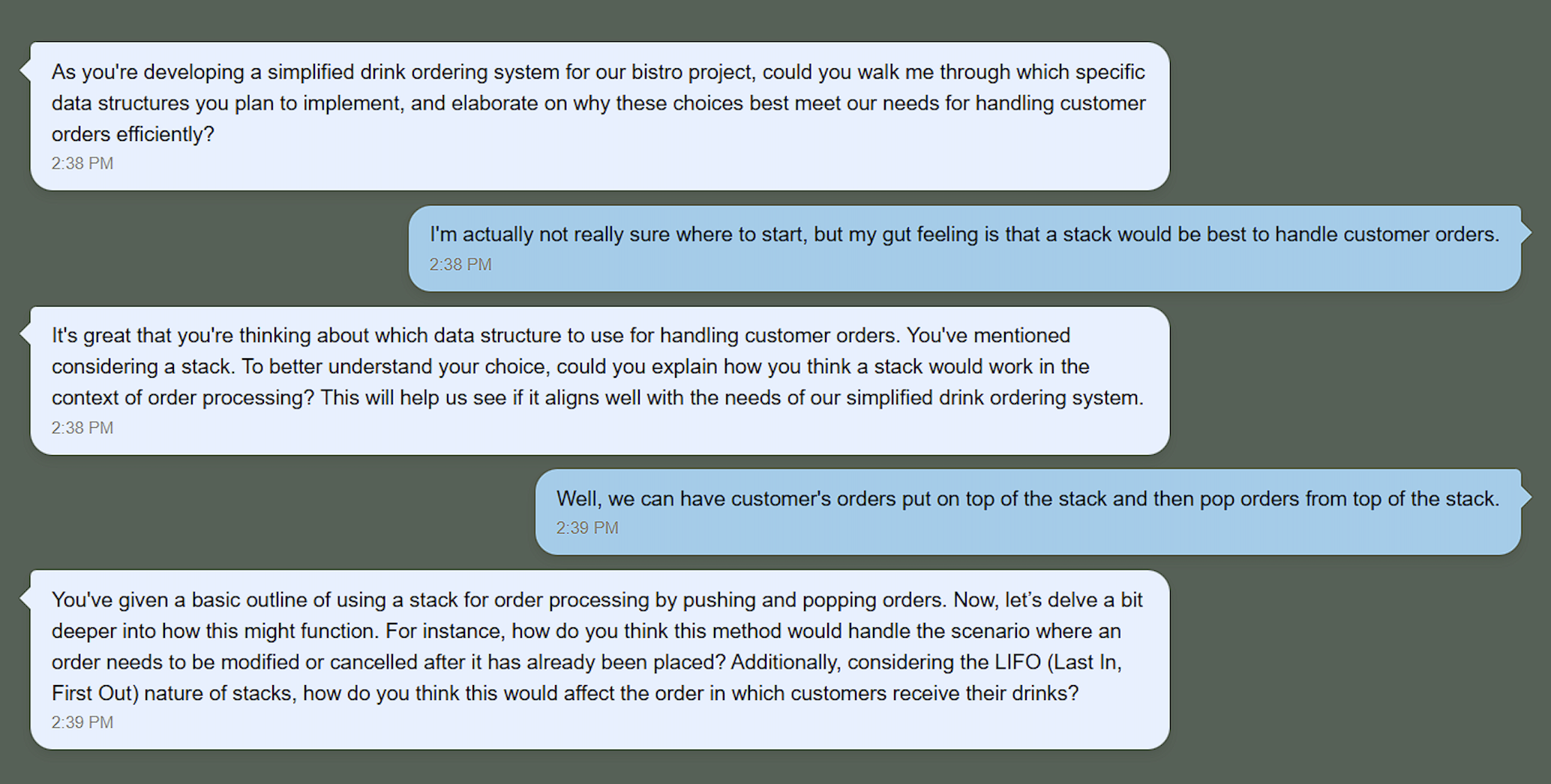
Conversation scaffold operationalizing the Feynman-inspired Explain → Predict → Reflect → Revise loop.
Control: Interaction Snapshot (Unstructured Wrapper)
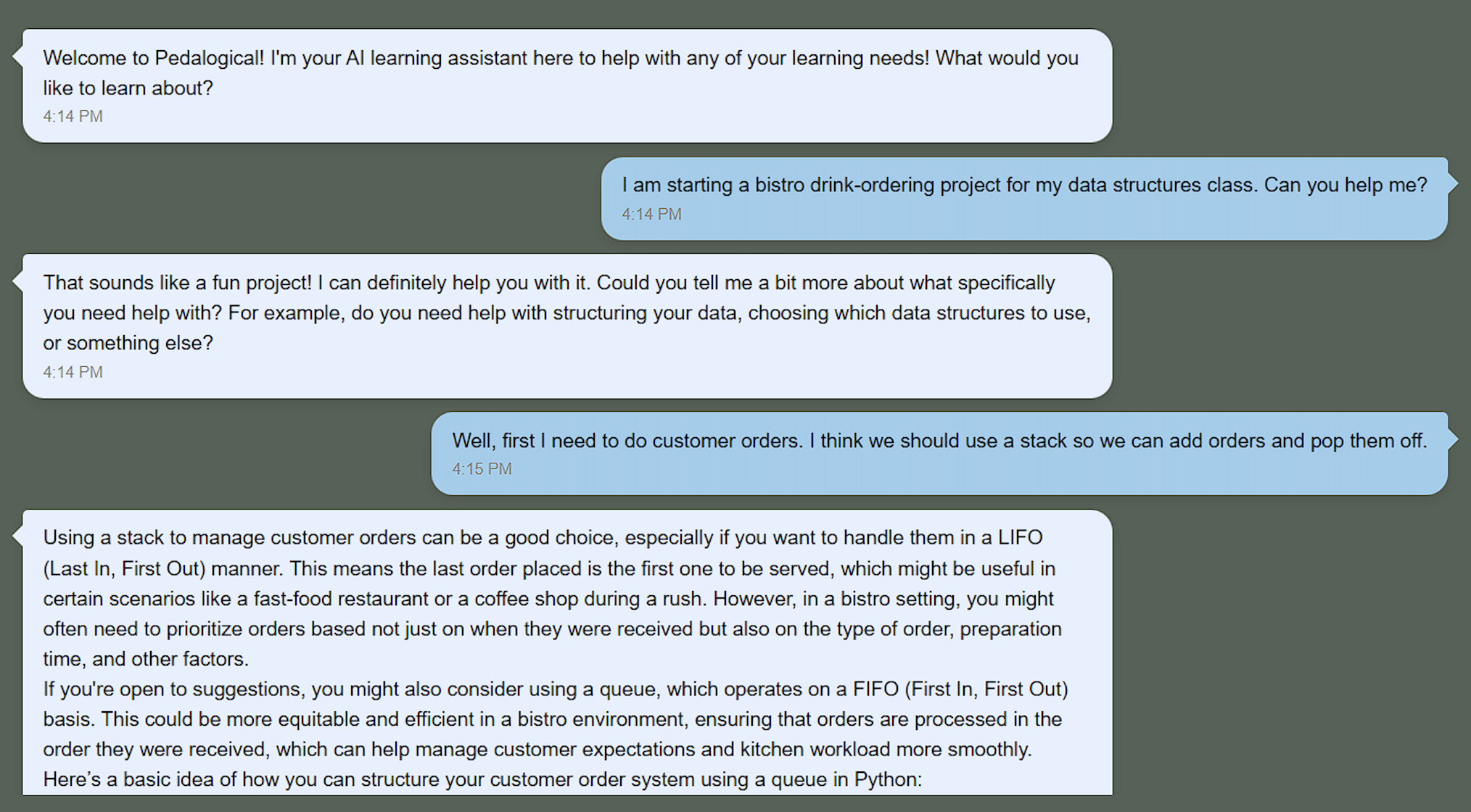
Conversation scaffold operationalizing the Feynman-inspired Explain → Predict → Reflect → Revise loop.
Measures & analysis
- Blind TA grading; five 20‑pt rubric dimensions.
- Overall scores; category scores; logs; short survey.
- Ethics: IRB‑approved; de‑identified; participation voluntary.
Results
Overall performance
- Structured: 92.7 (SD 3.8) vs. Unstructured: 74.3 (SD 10.2).
- Independent‑samples t‑test: t = 6.93, p < .000001; Cohen’s d = 2.14.
- Lower variance in treatment → more equitable outcomes.
Where did it help most?
- Functional implementation (p < .0001)
- Data structure usage & justification (p = .0002)
- Report accuracy (p = .0005)
- Documentation quality (p < .0001)
- No sig. diff. in code modularity/style (p = .27).
Interpretation
- Pedagogical structure—not just access—drives conceptual gains.
- Scaffolding mitigates automation bias; promotes reflective practice. [11, 23]
- Mirrors prior findings on explanation‑based learning and metacognition. [1, 16, 23]
Total Project Scores by Condition
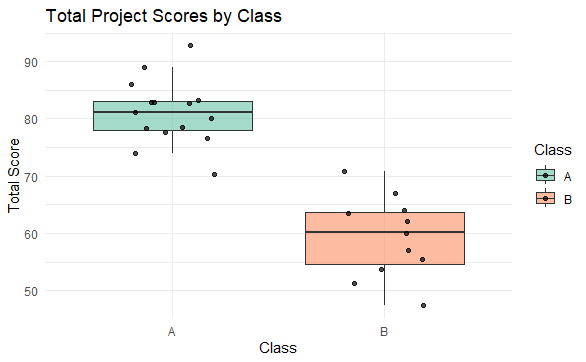
Boxplot illustrating higher average and lower variance for the structured condition. Based on synthetic samples approximating reported summary statistics (92.7±3.8 vs. 74.3±10.2; n=19/17).
Category Scores by Condition

Schematic relative visualization reflecting significant gains in four rubric categories and no sig. difference in modularity/style. Exact means not reported in paper; shown as proportional (baseline=1.0).
Validity & Limitations
Threats to validity
- Quasi‑experimental; section assignment (selection bias).
- Engagement confound (gated prompts vs. free use).
- Product‑oriented outcomes; limited metacognitive measures.
- Single institution/course; evolving LLM behavior.
Conclusion & Future Work
Takeaways
- AI’s impact is not pedagogically neutral. Design matters.
- E‑P‑R‑R scaffolding produced large gains (d = 2.14) where it counts.
- Provides a replicable blueprint aligned with IT2017/CS2023. [4, 14]
Where next?
- Randomized, cross‑institutional replications.
- Domain‑specific scaffolds (cybersecurity, systems, networking).
- Longitudinal learning & transfer; adaptive scaffolds; instructor authoring tools.
Thank You!
Lucas Cordova
Join our lightning talk!
- 11:15 AM - 11:30 AM: Room LRC-107
References
References Cited
[1]
J. Finnie-Ansley, J. Becker, M. Denny, P. Luxton-Reilly, B. Simon, and A. Petersen, “Patterns of student use and perceptions of generative AI in advanced computing courses,” in Proceedings of the 56th ACM technical symposium on computer science education (SIGCSE ’25), New York, NY, USA: ACM, 2025, pp. 123–131. doi: 10.1145/3626252.3627589.
[2]
S. Groothuijsen, A. van den Beemt, J. C. Remmers, and L. W. van Leeuwen, “AI chatbots in programming education: Students’ use in a scientific computing course and consequences for learning,” Computers and Education: Artificial Intelligence, vol. 5, p. 100290, 2024, doi: 10.1016/j.caeai.2024.100290.
[3]
M. Y. H. Low, C. C. Lee, K. K. Lee, and K. L. Lam, “Enhancing the teaching of data structures and algorithms using AI chatbots,” in 2024 IEEE international conference on teaching, assessment and learning for engineering (TALE), IEEE, 2024, pp. 1–8. doi: 10.1109/TALE62452.2024.10834293.
[4]
X. Zhai et al., “Would ChatGPT-facilitated programming mode impact college students’ programming behaviors, performances, and perceptions? An empirical study,” International Journal of Educational Technology in Higher Education, vol. 21, no. 1, p. 14, 2024, doi: 10.1186/s41239-024-00446-5.
[5]
D. J. Liu, J. Markel, and D. J. Malan, “Teaching CS50 with AI: Leveraging generative artificial intelligence in computer science education,” in Proceedings of the 55th ACM technical symposium on computer science education v. 1 (SIGCSE 2024), New York, NY, USA: ACM, 2024, pp. 796–802. doi: 10.1145/3626252.3630938.
[6]
J. Prather et al., “Metacodenition: Scaffolding the problem-solving process for novice programmers,” in Proceedings of the 25th australasian computing education conference (ACE ’23), New York, NY, USA: ACM, 2023, pp. 30–39. doi: 10.1145/3576123.3576130.
[7]
W. Yan, L. Zhang, W. Xu, and J. Zhou, “Scaffolding computational thinking with ChatGPT,” IEEE Transactions on Learning Technologies, vol. 17, pp. 1571–1584, 2024, doi: 10.1109/TLT.2024.3392896.
[8]
L. Kahn, E. S. Probasco, and R. Kinoshita, “AI safety and automation bias,” Center for Security; Emerging Technology, 2024. doi: 10.51593/20230057.
[9]
N. Kosmyna et al., “Your brain on ChatGPT: Accumulation of cognitive debt when using an AI assistant for essay writing task,” arXiv preprint arXiv:2506.08872, 2025, Available: https://arxiv.org/abs/2506.08872
[10]
R. I. A. Ambion, R. S. C. De Leon, A. P. R. Mendoza, and R. M. Navarro, “The utilization of the feynman technique in paired team teaching towards enhancing grade 10 ANHS students’ academic achievement in science,” in 2020 IEEE integrated STEM education conference (ISEC), IEEE, 2020, pp. 1–5. doi: 10.1109/ISEC49744.2020.9397848.
[11]
C. Y. Wang, B. L. Gao, and S. J. Chen, “The effects of metacognitive scaffolding of project-based learning environments on students’ metacognitive ability and computational thinking,” Education and Information Technologies, vol. 29, pp. 5485–5508, 2024, doi: 10.1007/s10639-023-12031-z.
[12]
K. Wach et al., “The dark side of generative artificial intelligence: A critical analysis of controversies and risks of ChatGPT,” AI and Ethics, 2024, doi: 10.1007/s43681-024-00443-4.
[13]
C. C. Cao, Z. Ding, J. Lin, and F. Hopfgartner, “AI chatbots as multi-role pedagogical agents: Transforming engagement in CS education,” arXiv preprint arXiv:2308.03992, 2023.
[14]
L. Chen, M. Smith, and R. Johnson, “Scaffolded AI chatbots for enhancing scientific reasoning in undergraduate education,” in Proceedings of the 2025 ACM conference on learning at scale (l@s ’25), 2025. doi: 10.1145/3591234.3595678.
[15]
C. Chhetri and V. Motti, “Exploring large language model-powered pedagogical approaches to cybersecurity education,” in Proceedings of the 25th annual conference on information technology education, ACM, 2024, pp. 314–319. doi: 10.1145/3686852.3686887.
[16]
M. Mukherjee, N. T. Le, Y.-W. Chow, and W. Susilo, “Strategic approaches to cybersecurity learning: A study of educational models and outcomes,” Information, vol. 15, no. 2, p. 117, 2024, doi: 10.3390/info15020117.
[17]
A. Gummadi, K. Santosh, S. S. C. Mary, and B. K. Bala, “Human centric explainable AI for personalized educational chatbots,” in 2024 international conference on advanced computing and communication systems (ICACCS), IEEE, 2024, pp. 328–334. doi: 10.1109/ICACCS60874.2024.10716907.
[18]
S. O. Akinola, B. O. Akinkunmi, and T. S. Alo, “Learn like feynman: Developing and testing an AI-driven feynman bot,” in 2024 IEEE international conference on teaching, assessment, and learning for engineering (TALE), IEEE, 2024, pp. 1–8. doi: 10.1109/TALE62557.2024.10834370.
[19]
M. Haase, “Feynman technique for learning programming and computer science,” Medium: Programming Education Blog, 2022.
[20]
J. Sweller, J. J. van Merriënboer, and F. Paas, “Cognitive architecture and instructional design: 20 years later,” Educational Psychology Review, vol. 31, no. 2, pp. 261–292, 2019.
[21]
L. Vygotsky, Mind in society: Development of higher psychological processes. Cambridge: Harvard University Press, 1978.